
U.S. cost guide · updated September 9, 2026
How much does asphalt driveway installation cost in 2026?
A straightforward new asphalt driveway is a useful early-planning exercise at $7–$13 per square foot. Full removal and replacement is closer to $8–$15 per square foot. Those ranges are the opening scene—not the ending—because two identical rectangles can hide very different soil, drainage, access, and demolition work.
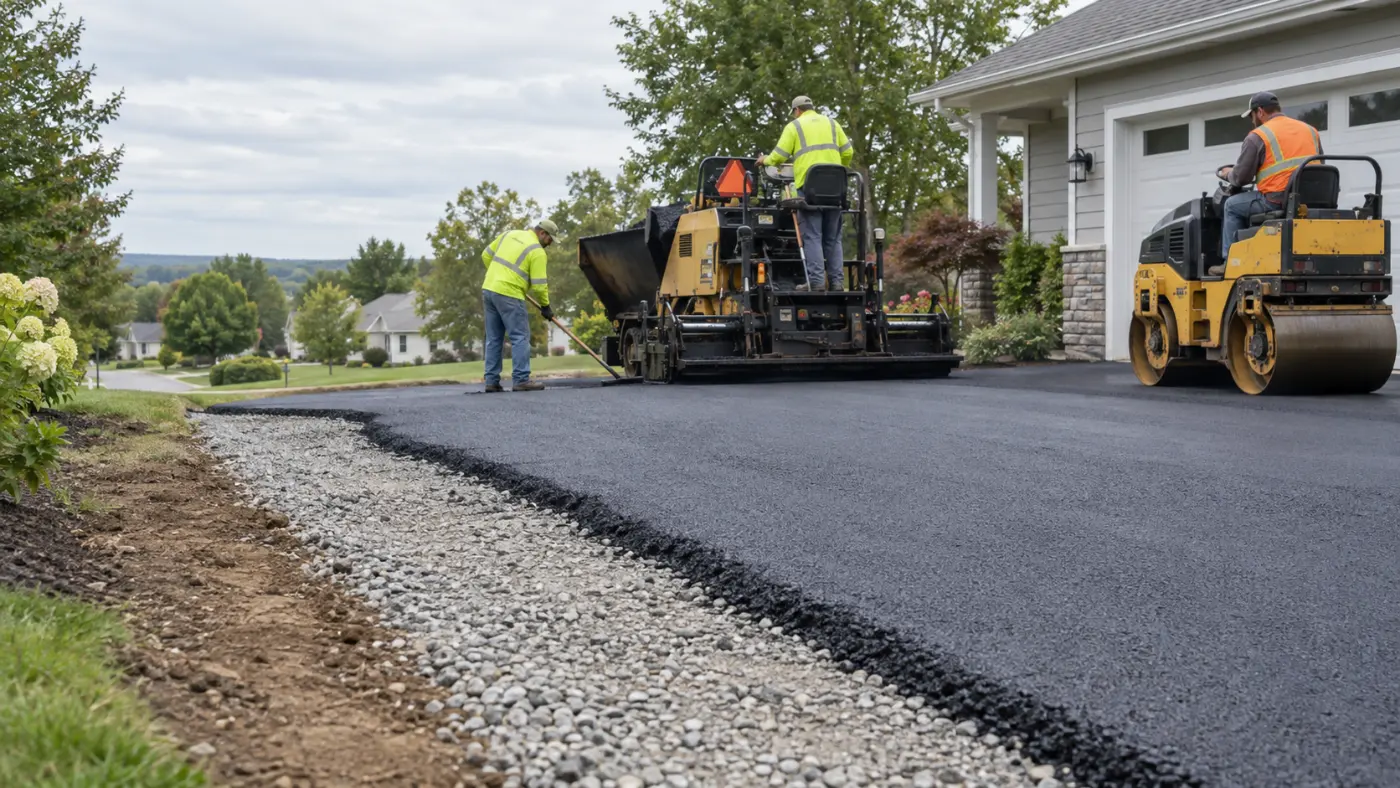
Square footage drives the total: at the same $7–$13 rate, a 500-square-foot driveway budgets at $3,500–$6,500, 800 square feet budgets at $5,600–$10,400, and 1,500 square feet budgets at $10,500–$19,500. If you don't know your driveway's area, multiply measured length by width in feet—a typical two-car driveway is roughly 20 × 30 ft (600 square feet). Local labor, material prices, access, and ground conditions change the unit price itself.
Hot-mix asphalt material alone typically runs $90–$160 per U.S. ton as a broad planning benchmark. Delivery, labor, base preparation, taxes, and minimum-load fees are separate from that material-only figure.
These planning ranges are editorial—synthesized from the scope bands used across our five state guides and checked by arithmetic across common driveway sizes. A straightforward new installation starts around these numbers; an overlay over sound pavement costs less ($4–$8/ft²), and a full tear-out and rebuild with base correction costs more ($8–$15/ft²). The tables below break each project type out so you can match the range to your actual job.
Start with scope
Asphalt driveway cost by project type
“What does asphalt cost?” sounds like one question. In practice, it is four. A shallow patch, a thin overlay, a new driveway on a prepared site, and a failed driveway rebuilt from below are different construction scopes. Treating them as interchangeable is how a bargain estimate turns into a surprise invoice.
2026 planning range per square foot
Each bar uses the same $0–$15 scale.
Reference per repaired square foot; not a driveway installation scope
Only over a sound, stable section
Straightforward installation
Remove existing pavement and rebuild
A simple project in a lower-cost market may approach $5 per square foot. At the other end, weak soil, complicated drainage, thick sections, handwork, long trucking distances, or restricted urban access can push a legitimate quote above the displayed ranges. A higher per-square-foot quote on a small job is not automatically a sign of overcharging: mobilizing a paver, roller, crew, and hot-mix delivery creates a real minimum cost before the first square foot is placed.
Rectangle meets reality
Asphalt driveway installation cost by size
Multiply measured area by a range that matches the scope. For example, an 800-square-foot driveway is about $5,600–$10,400 new, $6,400–$12,000 for full replacement, or $3,200–$6,400 for a suitable overlay. The table applies the same national planning ranges consistently; it does not pretend every site has the same bid.
| Area | Example footprint | New · $7–$13/ft² | Replace · $8–$15/ft² |
|---|---|---|---|
| 240 ft² | Short single-car | $1,680–$3,120 | $1,920–$3,600 |
| 480 ft² | Two-car parking pad | $3,360–$6,240 | $3,840–$7,200 |
| 600 ft² | Two-car driveway | $4,200–$7,800 | $4,800–$9,000 |
| 900 ft² | Wide or longer drive | $6,300–$11,700 | $7,200–$13,500 |
| 1,500 ft² | Large residential drive | $10,500–$19,500 | $12,000–$22,500 |
Area is only the visible multiplier. The tonnage underneath depends on compacted thickness and density. At 145 lb/ft³, one short ton covers about 82.8 ft² at 2 inches, 55.2 ft² at 3 inches, or 41.4 ft² at 4 inches. An 800-square-foot, 3-inch driveway therefore needs about 14.5 short tons before waste and field allowances.
Location changes the lane
Compare asphalt driveway costs in five states
A national range is the map legend; local supply, climate, labor, hauling, permits, and site access draw the roads. These are AsphaltCalculator.ai editorial planning ranges used consistently across our current state guides. The material column is for hot mix at the plant or supplier planning level—it is not a delivered or installed quote.
| Market | Material only | New / installed | Full replacement |
|---|---|---|---|
| United States | $90–$160/ton | $7–$13 new | $8–$15 |
| Texas | $85–$135/ton | $7–$13 new | $8–$15 |
| Florida | $100–$150/ton | $5–$12 installed | Not separately published |
| Pennsylvania | $105–$170/ton | $7–$13 new | $8–$15 |
| New York | $115–$185/ton | $7–$13 new | $8–$15 |
| California | $120–$190/ton | $7–$14 new | $9–$17 |
| State | Local cost context |
|---|---|
| Texas | Heat, heavy rain, expansive clay, and long plant hauls can add base and drainage work despite the lowest material range among these five guides. |
| Florida | Heavy rain and sandy, organic, or saturated soils make drainage and soft-base preparation important site variables. Florida publishes one installed planning range, not a separate replacement range. |
| Pennsylvania | Freeze-thaw conditions, wet bases, hillside grading, and constrained urban access can change the budget. |
| New York | Downstate labor, access, disposal, and permit costs can create substantial differences from upstate jobs. |
| California | Tight urban access and hillside excavation add scope; planning ranges extend above the national benchmark, particularly for replacement. |
These are five regional guides, not a nationwide ranking. Installed rates do not necessarily follow the material-price order because labor, soil, drainage, access, disposal, and permits also change the job. Compare project scope before calculating which state appears cheaper by a percentage.
The seven cost drivers
Why two same-size driveways get different quotes
1. Area and geometry
Long straight runs suit machines. Curves, aprons, tight edges, and handwork slow placement even at the same square footage.
2. Compacted thickness
Three compacted inches uses 50% more mix than two. A quote should say compacted—not loose—thickness.
3. Base and subgrade
Soft, wet, expansive, or frost-susceptible support can require excavation, stabilization, aggregate, and extra compaction.
4. Removal
Saw cutting, breaking, loading, hauling, and disposal separate replacement from paving an already prepared site.
5. Drainage
Correcting grade, outlets, culverts, or channel drains can cost more now and prevent premature pavement or building-water problems.
6. Mix and material
Mix availability, local specifications, trucking time, and the selected pavement section change quantity and price.
7. Access, hauling, and labor
Tight urban access can increase execution cost; rural work may add a longer haul from the asphalt plant. Both can matter for hot material and equipment scheduling.
Price is built in layers
Surface water also needs a reliable path away from the pavement and foundation. Base and drainage are among the factors most likely to separate a durable driveway from one that can fail prematurely.
Choose the operation
New driveway, overlay, or full replacement?
A new driveway starts where no paved section exists and may include clearing, excavation, subgrade preparation, aggregate, grading, and asphalt. An overlay adds asphalt over an existing surface that is still structurally stable, correctly graded, and well drained. It cannot erase a failing base. Full replacement removes the old pavement so the contractor can repair deeper trouble before rebuilding.
Recurring potholes, widespread alligator cracking, pumping fines, sunken wheel paths, broken edges, or water that never finds an outlet are reasons to investigate below the surface. Read our pothole diagnosis and repair guide before assuming a black overlay will solve a base problem. If runoff is heading toward the house, our driveway slope and basement-water guide is coming soon.
Make the rectangle talk
Estimate tonnage before comparing bids
Enter your driveway dimensions and planned compacted thickness. The calculator translates geometry into tons, coverage, and a material-only planning range—useful audit numbers, not an installed quote.
Open the free asphalt calculator →Compare scopes, not bottom lines
How to compare asphalt driveway quotes
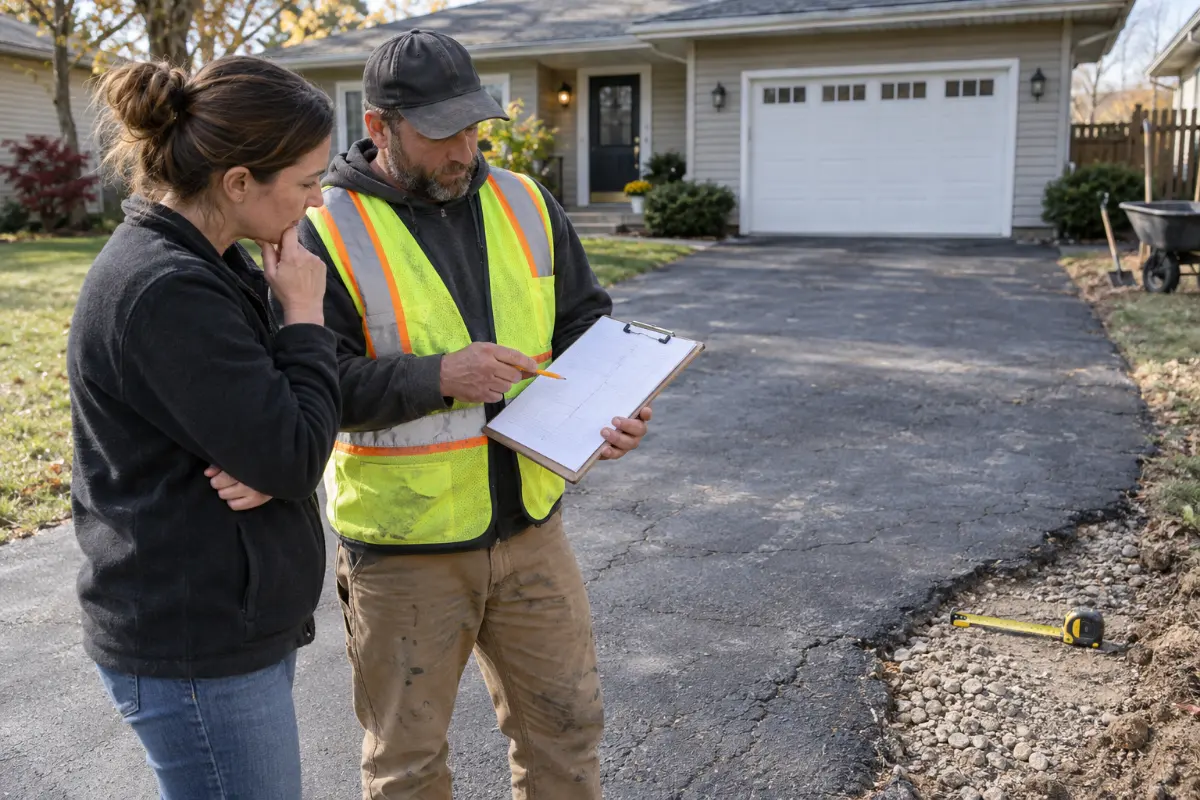
Getting three quotes is not the goal—getting three comparable scopes is. Give every contractor the same measured project limits and intended vehicle use, then ask the same six questions.
| No. | Question and what to confirm |
|---|---|
| 1 | What is the final compacted asphalt thickness? Ask for the finished number, rather than the loose depth before rolling. This tells you what pavement thickness is being priced. |
| 2 | What base preparation is included, and how much aggregate will be added or replaced? Ask for the aggregate thickness and the extent of base correction in writing—this is often one of the biggest differences between quotes. |
| 3 | Does the price include removal, hauling, and disposal of the existing pavement? Confirm all three. A bid can include tear-out while leaving haul-off or disposal outside the price. |
| 4 | How will grading and drainage be handled? If there is standing water, a slope, or a culvert, ask for the proposed solution and where runoff will go. |
| 5 | What asphalt mix is being used, and is trucking and delivery included? Confirm the specification and delivery scope so both bids price the same assumptions. |
| 6 | What is excluded from the quote, and what could trigger a change order? Ask about permits, soft spots, extra base, and unexpected excavation. This is where many unexpected costs show up. |
Why $7,500 and $9,000 may describe different jobs
Suppose Contractor A quotes $7,500 and Contractor B quotes $9,000. If B includes more base correction, drainage, disposal, and a thicker finished pavement section, the two totals describe different work. The higher figure alone does not establish overpricing.
When two quotes differ, ask whether the difference comes from material quantity, construction scope, or contractor execution cost. Put bids side by side only after confirming they describe comparable work, and ask why before assuming either contractor is wrong. Site conditions that are not explicitly modeled are not fully captured by a simple online estimate.
Also compare measured square footage, apron and tie-in limits, equipment access, traffic control, cleanup, restoration, payment schedule, workmanship warranty, and change-order unit prices.
After the roller leaves
Opening and maintaining a new asphalt driveway
Light vehicle use may be possible after roughly 48–72 hours under suitable conditions, but prolonged parking can require longer—especially in heat. Follow the contractor’s instructions for the actual mix, temperature, thickness, and site. Asphalt continues hardening for months after it becomes usable, so avoid sharp turns, concentrated loads, and kickstands on young or hot pavement.
Sealcoating is not an automatic next-week ritual. The Asphalt Institute notes that a well-designed, low-traffic new pavement may not need a sealcoat for roughly two to five years. Let pavement condition, climate, product instructions, and qualified local advice guide timing rather than applying a universal calendar. With sound design and construction, a residential asphalt driveway may serve roughly 15–30 years, but drainage, traffic, climate, and maintenance keep a hand on that clock.
Quick questions
Asphalt driveway installation cost FAQ
How much does asphalt driveway installation cost per square foot?
For early 2026 planning, use about $7–$13 per square foot for a straightforward new asphalt driveway and $8–$15 per square foot for full removal and replacement. A simple project in a lower-cost market may approach $5 per square foot, while difficult access, drainage correction, weak soil, or a thick engineered section can exceed these ranges.
How much does an 800-square-foot asphalt driveway cost?
At the planning ranges used in this guide, an 800-square-foot new driveway is about $5,600–$10,400. Full removal and replacement is about $6,400–$12,000, while a suitable overlay is about $3,200–$6,400. These are scope-based estimates, not contractor quotes.
How many tons of asphalt are needed for a driveway?
At a planning density of 145 pounds per cubic foot, one short ton covers about 82.8 square feet at 2 inches compacted, 55.2 square feet at 3 inches, or 41.4 square feet at 4 inches. An 800-square-foot driveway at 3 inches needs about 14.5 short tons before waste and field allowances.
Is asphalt always cheaper than concrete for a driveway?
Asphalt is often cheaper upfront, but not always. Local material supply, excavation, base work, drainage, access, finish choices, and project minimums can make asphalt and concrete bids overlap. Compare equivalent pavement sections and complete scopes rather than material labels alone.
How long does a new asphalt driveway last?
A well-designed, properly installed residential asphalt driveway may last roughly 15–30 years. Climate, drainage, subgrade support, traffic, construction quality, and timely condition-based maintenance all influence service life.
When can I drive on new asphalt?
Light vehicle use may be possible after about 48–72 hours under suitable conditions, but prolonged parking can require longer, especially during hot weather. Follow the paving contractor’s site-specific instructions. Asphalt continues hardening for months after it becomes usable.
Method and limits
Where these numbers come from
AsphaltCalculator.ai treats these figures as editorial planning ranges—not official national averages. We synthesized the scope bands used across our five current state guides, checked the arithmetic by driveway size, and kept material-only ton prices separate from installed costs. Prices are rounded because a false decimal place cannot inspect your subgrade.
Engineering guidance informs the non-price discussion. The Asphalt Institute engineering FAQs cover pavement thickness, compaction, and maintenance context. The U.S. Department of Energy’s Building America Solution Center drainage guide explains why final grade should carry water away from foundations. Residential requirements and market prices remain local; obtain a site evaluation and multiple written bids.
Related state guides and tools