
Driveway repair guide · published August 16, 2026 · updated September 6, 2026
How to fix a pothole in your asphalt driveway
Whether you call it a small pit, sunken spot, or pothole, the broken area in your driveway needs more than a cosmetic smear. A depression without missing material is not technically the same as a developed pothole, but cracked edges can admit water and the support below may have moved. Before any DIY asphalt pothole repair, answer one question: did only the asphalt fail, or did the base fail too?
Jump to the repair decision ↓Start with the evidence around the pit
A shallow depression, broken rim, loose aggregate, and short radiating cracks tell different parts of the same story. The asphalt has been deformed or fractured rather than merely discolored. Look beyond the visible center: cracks can extend into material that still appears flat, and a low spot can direct rain toward the opening.
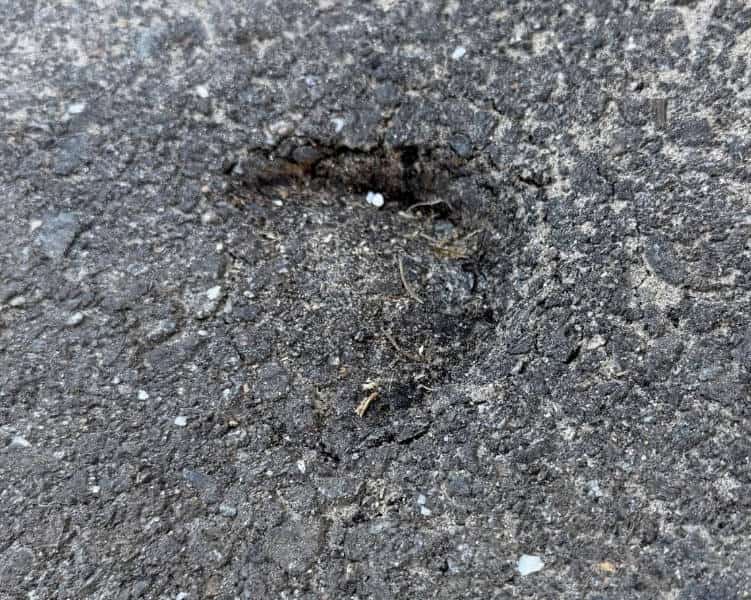
A photograph cannot confirm what is happening below the surface. It also cannot prove that a particular machine, contractor, or weather event caused the damage. Note when the pit appeared, whether it changes after rain, whether nearby cracks are growing, and what loads recently occupied the area. Those facts make an on-site diagnosis more useful.
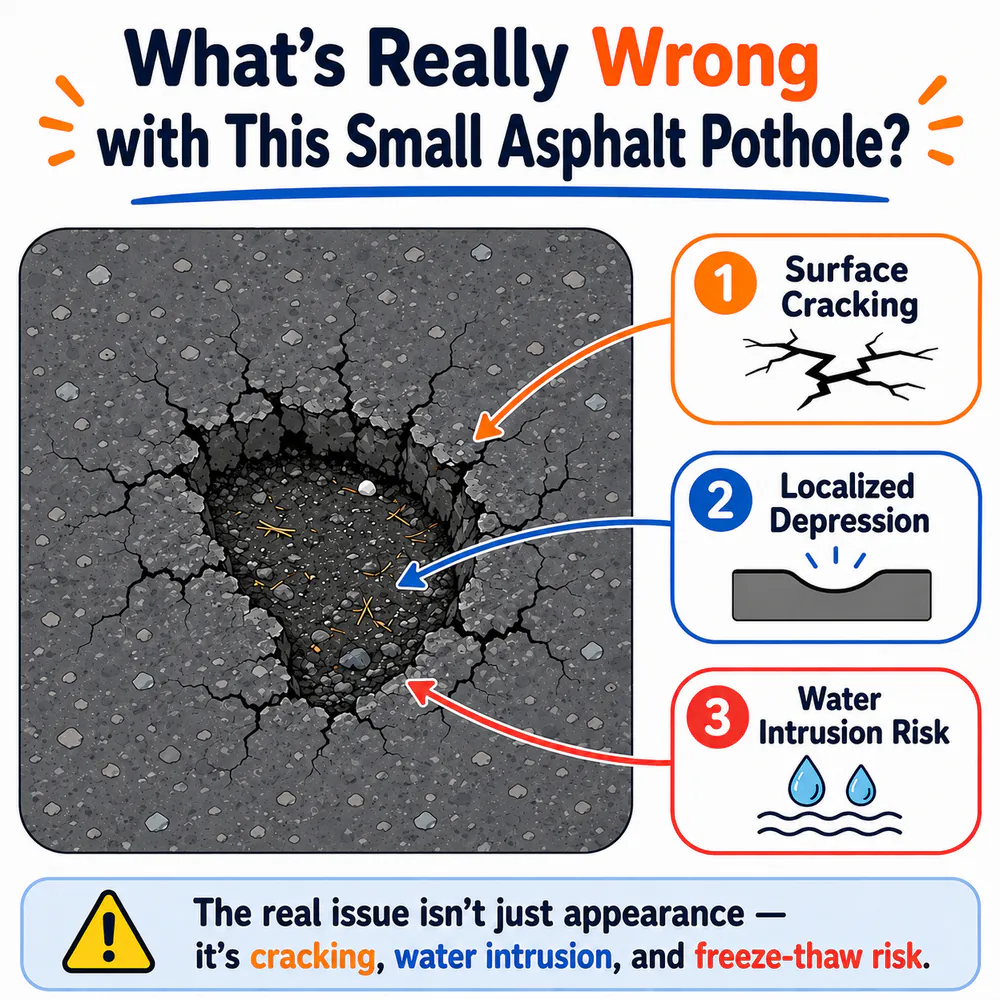
Three signals that a small asphalt pit matters
First, the surface is no longer continuous. Second, the center has lost elevation or material. Third, the opening gives water a route into the pavement. None of those observations automatically means the whole driveway needs replacement, but together they argue against treating the spot as a harmless blemish.
How concentrated equipment loads can start the damage
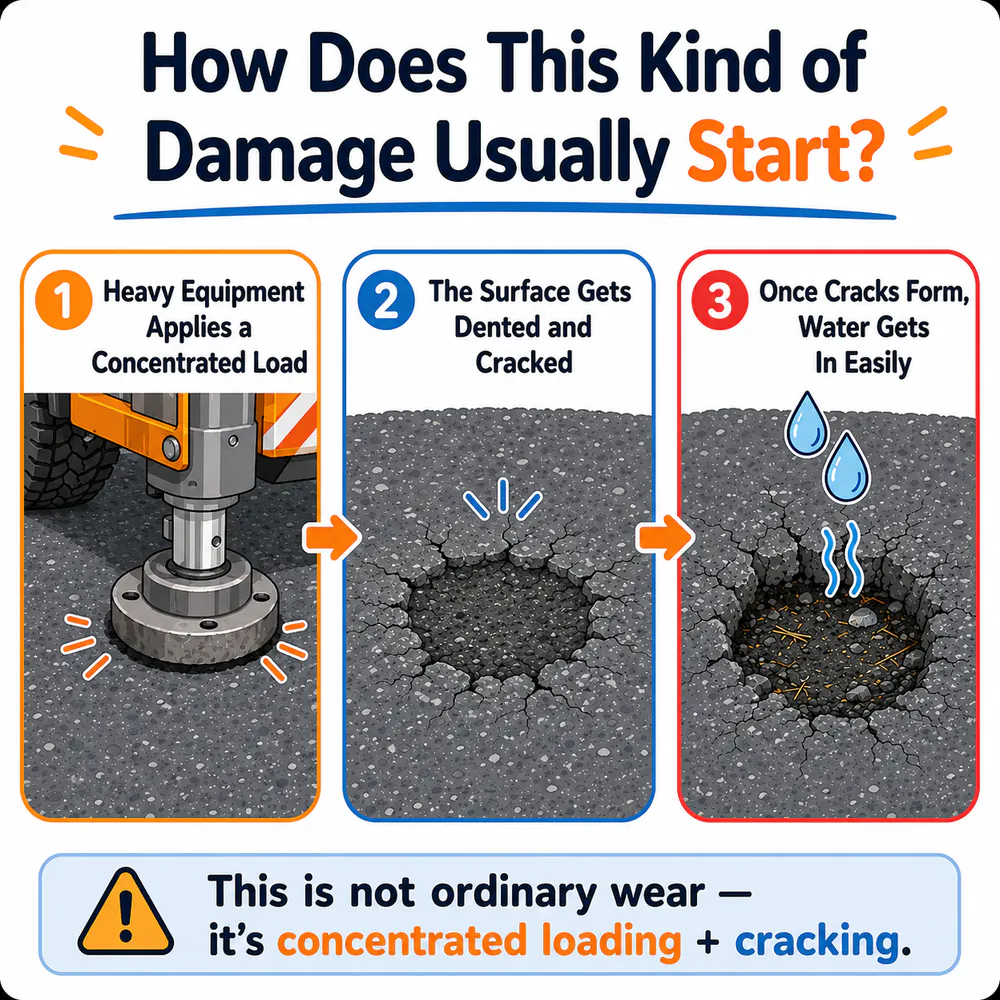
Tree work, construction, moving, and deliveries can place unfamiliar loads on a residential driveway. An outrigger foot, stabilizer, dumpster leg, narrow tire, or the edge of a track transfers weight through a much smaller contact area than a passenger-car tire. That concentrated pressure can dent warm asphalt, crack a thin surface, or reveal a weak spot below it.
Risk depends on equipment weight and setup, pavement temperature, contact area, asphalt and base thickness, soil support, drainage, and distance from the driveway edge. A load-distribution mat can spread force over a larger area, but “put down a board” is not a universal engineering rule. The operator remains responsible for evaluating ground support and using appropriately designed supporting materials.
Why water, freeze-thaw, and traffic enlarge a small pit
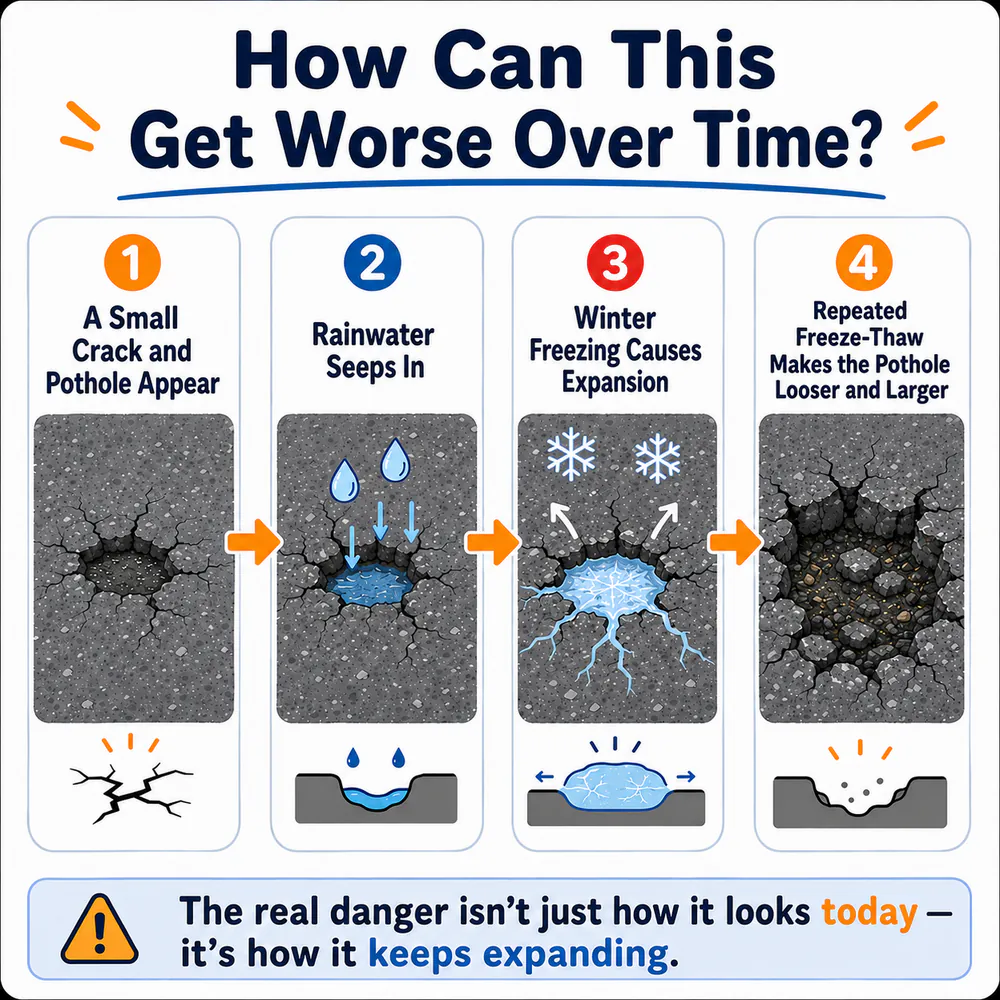
Rain can collect in the depression and enter cracks around it. If the base becomes wet or fine material is displaced, support may weaken. Vehicle tires then flex and abrade the broken edge. In cold regions, water that freezes can expand and help widen existing openings; thaw leaves the area wet just as loads return.
Freeze-thaw is not required for damage to grow. Repeated wetting, poor drainage, heat-softened asphalt, and normal traffic can loosen a failed spot in any climate. The practical lesson is the same: keep an open pit from becoming a water reservoir and do not let tires repeatedly strike the rim while waiting for repair.
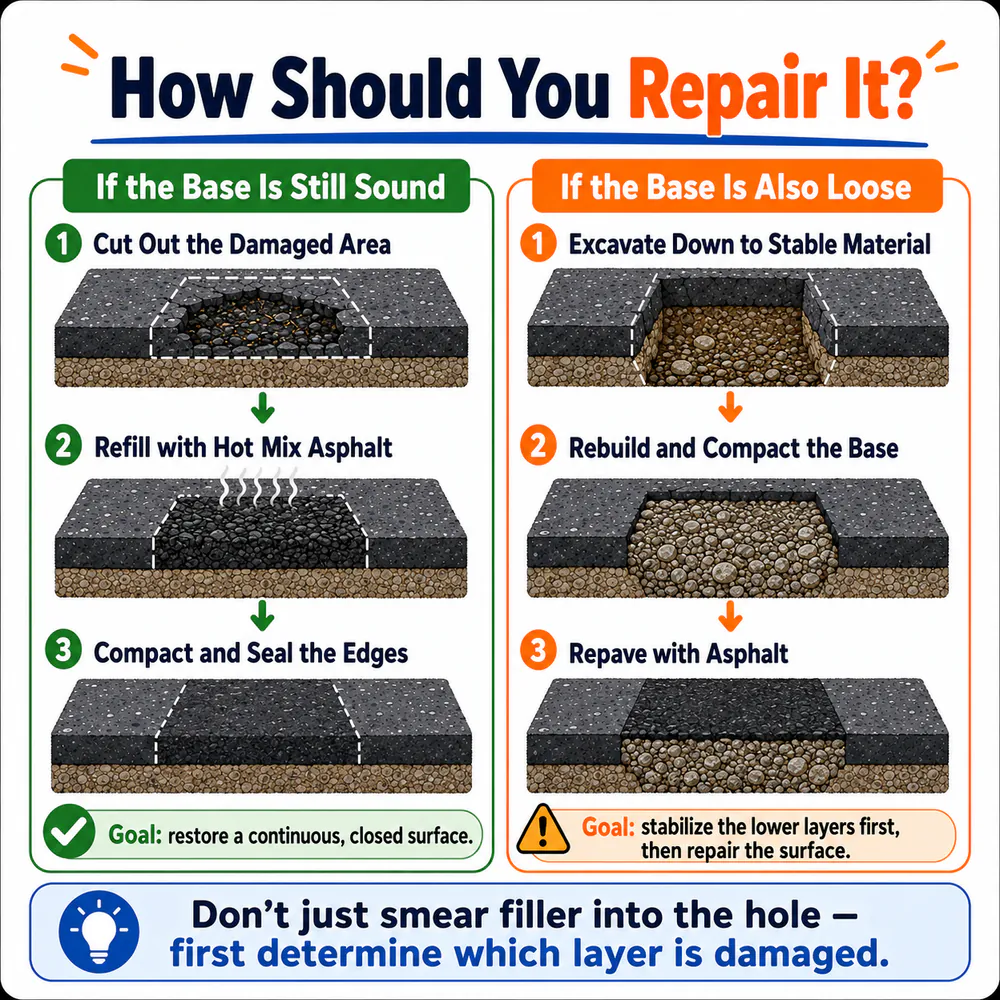
Surface patch or base rebuild? Diagnose the failed layer
A sound surrounding surface, firm support, and truly localized damage may allow a full-depth asphalt patch. The repair area is cut to stable boundaries, loose material is removed, the sides and bottom are prepared, and compatible asphalt is placed and compacted in the required lifts. The finished patch should shed water and meet the surrounding surface without a tire-catching edge.
Recurring settlement, widespread alligator cracking, a soft or pumping area, displaced aggregate, or an obviously unstable bottom points to deeper work. The contractor may need to excavate until the remaining material is stable, correct drainage or subgrade problems, rebuild and compact the aggregate base, and only then replace the asphalt. Covering movement with a thicker cap does not remove its cause.
DIY asphalt patch vs contractor repair: compare the repair path
Choose by support condition and the repair system—not by the visible diameter alone. Product depth limits, preparation, weather, and compaction requirements still control each application.
Swipe sideways to compare all columns.
| Repair route | Best for | Depth and support rule | Expected role | DIY or pro |
|---|---|---|---|---|
| Packaged cold patch | Isolated hole; firm base | Follow product depth and lift limits | Role varies by system and preparation | Often DIY |
| Full-depth hot-mix patch | Failed surface; stable base | Remove failed asphalt to sound edges | Permanent surface repair | Contractor |
| Base rebuild plus asphalt | Soft, wet, displaced base or recurring settlement | Excavate to stable material; rebuild and compact | Structural support repair | Contractor |
Asphalt pothole repair cost: DIY cold patch vs hot mix
For a rough 2026 U.S. planning estimate, a small DIY cold-patch repair may use $10–$50 in bagged material. A small hot-mix patch may be budgeted at $100–$250 before deeper base work, while professional repair can run $150–$400+ once cutting, removal, compaction, mobilization, and access are included. These are editorial planning ranges supplied for this guide—not statistically sampled national averages, retail prices, or contractor quotes. A soft base, drainage repair, difficult access, or a contractor’s minimum charge can move the actual total outside them.
Swipe sideways to compare all columns.
| Repair scope | Planning range | What the range means |
|---|---|---|
| DIY cold patch | $10–$50 | Bagged material for a small isolated repair; tools and base work excluded |
| Small hot-mix patch | $100–$250 | Early patch allowance before deeper repair; small-load charges may dominate |
| Professional repair | $150–$400+ | May include cutting, removal, placement, and compaction; confirm the written scope |
How to fix a pothole in an asphalt driveway: DIY steps
These steps are for a small, isolated hole with firm support—not a deep collapse, spreading alligator cracks, pumping water, or an equipment-damage claim. Control traffic, wear the protection required by the tools and product, and postpone work when temperature or moisture falls outside the patch instructions.
- Mark stable boundaries. Look and probe beyond the visible hollow. The finished repair needs sound asphalt at its perimeter, not a thin feather edge over fractured material.
- Remove loose asphalt and debris. Clean the opening thoroughly. Saw cutting may be part of a professional full-depth repair, while a packaged DIY product may specify another edge preparation.
- Check the bottom and drainage. Compact sound aggregate if the repair system permits. Stop if the base is soft, saturated, displaced, or continues to move; it must be corrected before surface patching.
- Prepare the old asphalt for bonding. Sound faces must be clean. Apply tack or primer only when the selected material or repair specification calls for it because patch products are not interchangeable.
- Place compatible patch material in lifts. Stay within the product’s allowed depth and lift thickness. Hot mix normally requires a contractor and suitable equipment; cold patch can be practical for small DIY or temporary work.
- Compact and finish the patch. Compact the corners, edges, and center. Finish as the product directs, prevent a water-holding lip, treat the joint as specified, and keep traffic off for the stated time.
What is the best patch for a small hole?
The best material is the one designed for the hole depth, weather, traffic, and preparation you can actually provide. Hot mix is commonly preferred for a properly built permanent repair; a reputable cold patch is often more practical for DIY or emergency use. “Permanent” on a bag cannot compensate for loose edges or a failed base.
Will new asphalt stick to old asphalt?
Yes, when the old edge is sound and clean and the repair uses the specified tack, temperature, and compaction. It will not bond reliably to dust, loose aggregate, wet contamination, or moving asphalt. Bonding starts with edge preparation; it is not solved by pouring extra material over the joint.
Why smearing filler into the depression is not a diagnosis
Crack sealant, pourable filler, cold patch, and hot mix are different materials for different conditions. Filling only the visible hollow can bridge over loose asphalt, trap poor support in place, or create a thin feathered edge that breaks under traffic. A product is not a permanent repair merely because it hardens.
Follow the product’s weather, depth, preparation, and compaction instructions. Treat a DIY result as temporary if the pavement moves. Use a contractor for softness, standing water, spreading cracks, edge or drain damage, sudden equipment damage, or a possible claim.
Questions to ask before approving asphalt pothole repair
- How will you determine whether the base and subgrade are stable?
- Will you remove cracked material to sound boundaries or fill only the low spot?
- What patch material will you use, and is the repair temporary or permanent?
- What compacted depth and lift thickness will you provide?
- How will you compact the corners and edges, not just the center?
- Will you address water flow and finish the joint so it does not collect runoff?
- What is excluded if deeper instability becomes visible after excavation?
If equipment caused the damage, photograph every spot with a scale, record dates and communications, and request a written repair scope before the area is disturbed. That documentation is more useful than trying to assign fault from a single close-up image.
Prevent the next concentrated-load failure
Tell tree, crane, roofing, moving, and construction crews that access is over a residential asphalt driveway. Ask where outriggers, stabilizers, dumpsters, and tracked turns will be located and how their loads will be distributed. Keep heavy setups away from unsupported edges and known soft areas. On hot days, extra caution is appropriate because asphalt can be more susceptible to indentation.
Maintenance still matters after the equipment leaves. Direct runoff away from the pavement, repair open cracks with the correct treatment, support eroding edges, and investigate recurring depressions instead of repeatedly leveling the surface. Prevention is a combination of load planning, drainage, and a stable pavement structure—not sealcoating alone.
Planning a measured repair?
Estimate asphalt only after the repair boundary is known
Measure the cut area and compacted depth, then use our asphalt patch material calculator for an early volume and tonnage estimate. Small repairs may still be governed by contractor mobilization or plant minimums; the calculator does not estimate bags or installed repair cost.
Open the asphalt calculator →Asphalt pothole repair FAQ
How much does pothole repair cost?
For a rough 2026 U.S. planning estimate, bagged material for a small DIY cold-patch repair may cost $10–$50. A small hot-mix patch may be budgeted at $100–$250 before deeper base work, while professional repair can run $150–$400+ once cutting, removal, compaction, mobilization, and access are included. These are editorial planning ranges, not national averages or contractor quotes; drainage or base failure can raise the total substantially.
What's the difference between cold patch and hot mix for pothole repair?
Cold patch is a packaged asphalt repair material that can be practical for a small DIY repair, an emergency, or weather-limited work when the product permits it. Hot mix is produced at a plant, placed and compacted while hot, and normally requires a contractor and suitable equipment. A full-depth hot-mix patch is commonly preferred for a durable permanent repair when the base is sound. Choose by support condition, product limits, weather, and available compaction—not by a universal hole-size cutoff.
Can I repair a driveway pothole myself?
Yes, when the pothole is isolated and the surrounding asphalt and base are firm. Remove loose material to stable edges, clean the opening, check the support below, use tack or primer only when the selected repair system calls for it, place material within the product’s stated depth and lift limits, and compact every lift thoroughly. Hire a professional when the base is soft or wet, settlement recurs, alligator cracks spread outward, or the repair requires hot mix and powered compaction.
Sources and evidence boundaries
This guide applies general pavement-repair principles to residential driveways. Highway manuals and safety standards are useful technical context, but they are not a site diagnosis, a residential specification, or proof that a particular load caused damage. Local materials, weather, access, and pavement construction control the final repair.
- FHWA pothole-repair manual of practice (PDF) — preparation, sound repair boundaries, material placement, and compaction context for asphalt-surfaced pavements.
- OSHA 29 CFR 1926.1402 — ground-condition and supporting-material requirements for crane assembly and operation; it does not certify that a residential driveway can carry a given setup.
- Asphalt Institute engineering FAQs — general thickness, lift, tack, and compaction context.
Related posts and tools